



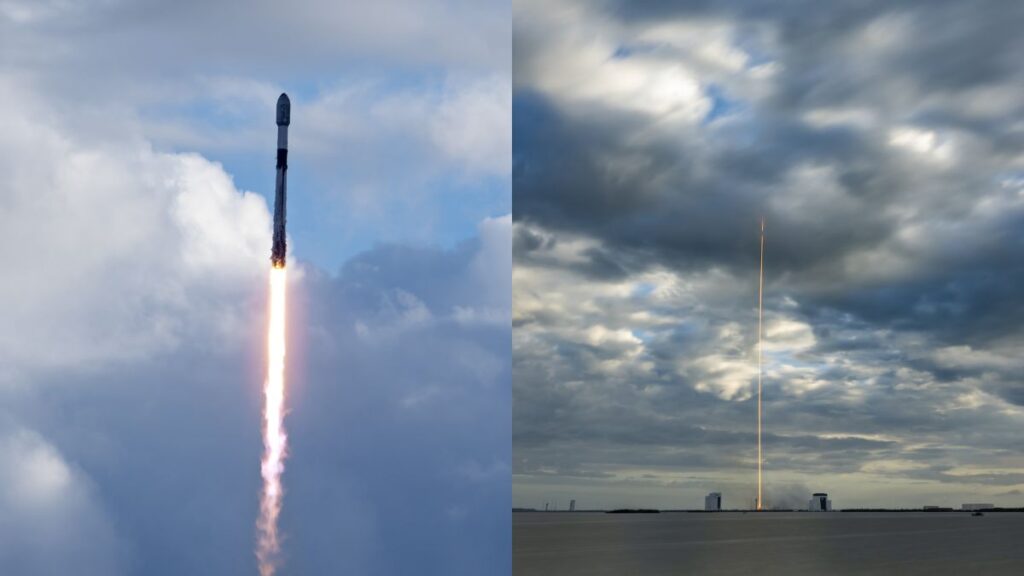
Many residents in Southern California saw streaks of light in the sky, assuming them to be meteors. However, it was the launch of the SpaceX satellites. Several people recorded videos of the launch with the rocket’s bright tails leaving the Earth’s surface. Those who do not follow the official account may not be able to tell the difference between a meteor and a satellite launch.
SpaceX confirmed the Falcon 9 launching 25 Starlink satellites into low-Earth orbit on March 16 at 10:19 pm. The satellites were launched from Space Launch Complex 4 East (SLC-4E) at Vandenberg Space Force Base in California.
According to SpaceX’s website, this marks the 14th flight for the first stage booster. Before this, it launched NROL-126, Transporter-12, SPHEREx, and NROL-57. The official website also confirmed the loud sonic booms that many residents may have heard in areas including Santa Barbara, San Luis Obispo, and Ventura.
Targeting this afternoon for Falcon 9’s launch of 25 @Starlink satellites to low-Earth orbit → https://t.co/AFOn4jxW37 pic.twitter.com/9prGbOK7TV
— SpaceX (@SpaceX) February 7, 2026
The launch event was also live-streamed on SpaceX’s X account and website, commemorating a historic addition to the fleet of satellites. Now SpaceX has more than 10,000 satellites orbiting the Earth. The website confirmed that the booster used in the mission had previously completed 13 flights before this launch. After the launch, it was expected to land on a ship in the Pacific Ocean.
The first Falcon 9 rocket launch added 25 satellites to orbit, and the second launch successfully added 29 satellites. The booster after the second launch landed on a droneship stationed in the Atlantic Ocean. This was the 378th Starlink launch, resulting in a successful mission.
Watch Falcon 9 launch 25 @Starlink satellites to orbit from California https://t.co/UOarP0wbQN
— SpaceX (@SpaceX) March 17, 2026
Apart from these successful launches, about 1,509 Starlink satellites have been destroyed after entering the Earth’s atmosphere. Starlink has been helping more than ten million people across the world, including remote Amazon areas and Ukraine.
These satellites give SpaceX CEO Elon Musk significant influence over internet connectivity in several regions, critics have noted. Over the years, Starlink has also seamlessly provided emergency support to first responders with a Wi-Fi hotspot and logistic support.
In an effort to compete with Musk, Jeff Bezos backed Amazon’s Leo, formerly Project Kuiper. It has already launched more than 200 satellites and plans to launch 7,500 more. Musk holds the title with the highest number of satellites so far.
Meanwhile, Guowang and Qianfan constellations backed by the Chinese government are planning to launch up to 13,000 to 15,000 satellites. After this, SpaceX may no longer have an upper hand in the situation.