



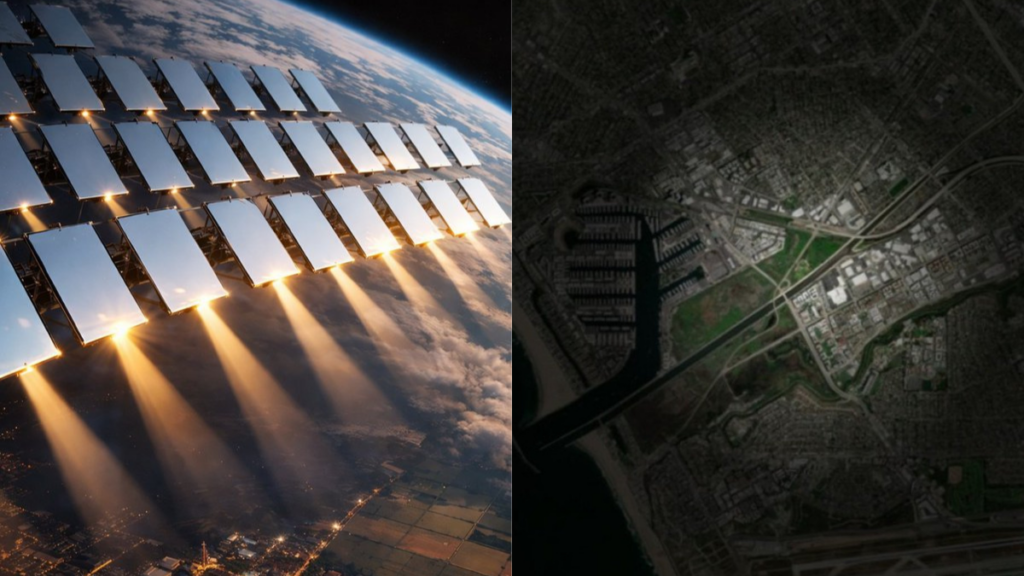
Scientists are exploring a controversial proposal that would involve launching massive space mirrors into orbit that are capable of reflecting sunlight back onto Earth after sunset — a concept that critics warn could seriously disrupt wildlife and plant life across the planet.
The space mirrors project centers on the idea of deploying satellites equipped with giant reflective panels that would redirect sunlight toward the Earth’s surface even after nightfall. Developers say the system could extend daylight for specific locations, but scientists and astronomers are sounding alarms about the potential consequences for ecosystems that depend on natural cycles of light and darkness.
The technology is being developed by Reflect Orbital, a California-based startup that aims to place satellites with deployable mirrors into orbit. The space mirrors would bounce sunlight toward selected areas on Earth, creating brief periods of artificial illumination during nighttime hours.
A startup wants to “sell sunlight” by bouncing it off mirrors in space.
A California startup is proposing to reshape Earth’s nights—literally—by launching 4,000 space mirrors to reflect sunlight back to the dark side of the planet.
Reflect Orbital, the company behind the plan,… pic.twitter.com/bRyyhEbglw
— Night Sky Now (@NightSkyNow) December 23, 2025
Under the proposed system, satellites orbiting roughly 600 kilometers above the Earth would direct reflected sunlight onto specific regions on the ground, according to a Daily Mail report. The reflected light from the space mirrors would pass over an area for several minutes as the satellite travels across the sky.
Reflect Orbital says the technology could have several potential uses beyond extending daylight. The company claims its space mirrors could allow solar power plants to continue producing electricity around the clock by reflecting sunlight onto solar farms after sunset. Developers also say the system could be used to illuminate disaster-stricken regions where power infrastructure has been damaged, and they have even suggested that reflected sunlight could one day replace traditional street lighting in some areas.
The company claims the space mirrors reflections would not replicate full daylight but would instead produce lighting levels closer to twilight or bright moonlight. However, scientists warn that artificially extending daylight could have profound effects on animals and plants that rely on darkness to regulate natural behaviors. Many species depend on nighttime darkness for migration, hunting, reproduction, and sleep cycles. Even relatively small changes in nighttime light levels can confuse wildlife and alter the rhythms that govern ecosystems.
Environmental experts warn that the impact on wildlife could by the space mirrors be even more troubling. Artificial light has already been shown to affect sea turtles, birds, insects, and other species that depend on darkness for survival. Expanding artificial light into the sky through orbiting mirrors could intensify those disruptions across large regions.
Plants rely on natural day-night cycles to regulate growth, flowering, and seasonal changes. Interrupting those cycles with artificial nighttime illumination could disrupt plant development and potentially affect crops that depend on predictable light patterns.
Critics say that altering the natural rhythm of daylight and darkness on a global scale carries risks that scientists still do not fully understand. Robert Massey of the Royal Astronomical Society warned that the project’s core concept could dramatically alter the night environment.
“The central goal of this project is to light up the sky and extend daylight and obviously, from an astronomical perspective, that’s pretty catastrophic,” Massey said.
Scientists warn that disrupting the planet’s natural light cycles with the space mirrors could have serious for Circadian rhythms — the biological clocks that help animals and plants determine when to sleep, feed, migrate, or reproduce — are strongly influenced by the natural pattern of daylight and darkness.
If those rhythms are disturbed, wildlife could begin behaving at the wrong times of year. Animals might attempt to breed when food supplies are scarce, hibernating species and insects could awaken during the depths of winter, and plants and crops may begin flowering when there are no pollinators available to sustain them.
Researchers also warn that additional artificial light in the night sky could confuse migratory birds, potentially triggering premature migrations that send them flying toward colder regions when they mistakenly believe warmer seasons have arrived.
Scientists studying the space mirrors proposal say the potential environmental consequences could be far-reaching. Martha Hotz Vitaterna, a neurobiologist at Northwestern University and co-director of the university’s Center for Sleep and Circadian Biology, warned that altering the natural cycle of light and darkness could have sweeping effects across ecosystems. “The implications for wildlife, for all life, are enormous,” she cautioned.
Reflect Orbital — which has already secured more than $28 million in investment funding — is not the first group to experiment with the idea of reflecting sunlight from space. In 1993, a Russian satellite known as Znamya deployed a 65-foot mirror that successfully reflected a beam of light toward Earth roughly as bright as two or three full moons. The space mirrors experiment was designed to test whether a small constellation of satellites could extend daylight hours in remote parts of Arctic Siberia.
“Whoops misadjusted the mirrors” pic.twitter.com/2SDpAjD3fw
— Val (osopher) (@Valen_T_N) March 7, 2026
But the proposal from Reflect Orbital goes far beyond those earlier experiments. The company says it aims to capture large amounts of sunlight that normally pass the planet and redirect that energy toward customers on demand, potentially selling reflected sunlight to governments, businesses, and other clients.
One of the biggest potential markets would be the rapidly expanding solar power industry, which currently faces a major limitation: solar panels stop generating electricity once the sun goes down.
Reflect Orbital has also outlined an aggressive timeline for expanding the technology. The company plans to launch two additional prototype mirrors by the end of 2027 before dramatically scaling up its system. According to current plans, Reflect Orbital hopes to deploy about 1,000 larger satellites by the end of the following year. The constellation could then grow to around 5,000 mirrors by 2030, eventually expanding to a massive network of roughly 50,000 orbiting mirrors by 2035.
Company leaders say the reflected sunlight would be sold as a service. Chief executive Ben Nowack has indicated that customers could pay roughly $5,000 for an hour of reflected sunlight from a single mirror if they sign an annual contract for at least 1,000 hours of service.
Reflect Orbital chief executive Ben Nowack said the long-term vision is far larger than simply extending daylight. “We’re trying to build something that could replace fossil fuels and really power everything,” he told The New York Times.
Astronomers are sounding the alarm as a California startup plans to deploy 4,000 orbital space mirrors raising serious concerns about light pollution and space sustainability. #SpaceNews #Astronomy #SpaceTechnology #OrbitalMirrors #Maxum pic.twitter.com/FM9bcvttjv
— Maxum (@maxumdigitalusa) December 23, 2025
Despite those concerns, Reflect Orbital says the illumination created by the mirrors would be limited and controlled. “Our service is highly localized,” representatives for the project said. “Each reflection covers a defined area for a finite period of time rather than providing continuous or widespread illumination.”
Environmental advocates have also raised alarms about the potential consequences of filling the night sky with artificial light. The advocacy organization DarkSky warned that projects like Reflect Orbital’s mirror satellites could create significant risks for the natural nighttime environment.
The group cautioned that introducing large sources of artificial light into the night sky could disrupt ecosystems that rely on the planet’s natural cycle of light and darkness. According to DarkSky, such illumination by space mirrors would represent an entirely new form of nighttime light pollution with far-reaching consequences for wildlife, plants, and ecosystems that depend on darkness to function properly. The organization also warned the technology could raise serious public safety concerns.
Critics say another issue is that federal regulators currently do not evaluate these environmental impacts when reviewing applications for space-based projects like space mirrors. Under existing policy, the Federal Communications Commission considers activities taking place in orbit to be outside the scope of Earth-based environmental review requirements.
That approach has raised concerns among astronomers and environmental groups. While companies such as SpaceX have taken voluntary steps to reduce the brightness of their satellites in order to protect the night sky,