



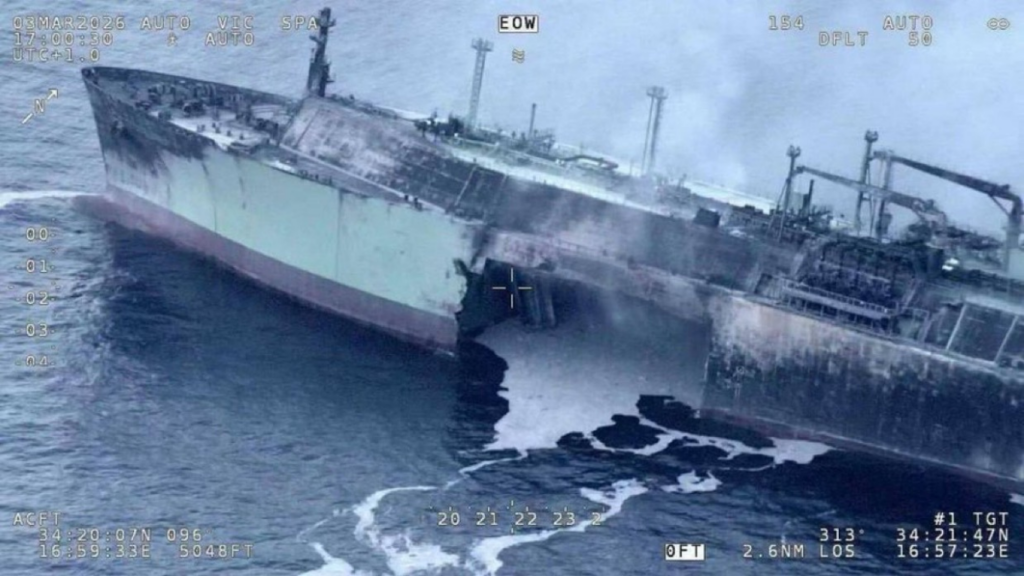
A U.S. Navy submarine has sunk an Iranian warship with a torpedo strike in a dramatic moment that military officials say marks the first time an American submarine has destroyed an enemy vessel in combat since the end of World War II in 1945.
The torpedo strike, confirmed by War Secretary Pete Hegseth, took place late Tuesday night in waters near the southern coast of Sri Lanka. The Iranian frigate — identified as the IRIS Dena — was operating roughly 44 nautical miles off the port city of Galle when it was struck by a torpedo fired from a U.S. submarine.
The torpedo attack quickly sent the warship to the bottom of the ocean. “An American submarine sunk an Iranian warship that thought it was safe in international waters,” Pete Hegseth said during a Pentagon briefing as he outlined the operation. “It was sunk by a torpedo — a quiet death,” he added.
https://t.co/PiqQpVIrMu pic.twitter.com/Wc1e0B0um7
— Department of War 🇺🇸 (@DeptofWar) March 4, 2026
The dramatic torpedo strike represents a historic milestone for the U.S. Navy. American submarines were responsible for sinking hundreds of enemy ships during World War II, but officials say a U.S. submarine had not torpedoed and sunk an enemy vessel in combat since 1945.
The Iranian ship targeted in the operation was one of the newest vessels in Tehran’s naval fleet. Commissioned in 2021, the IRIS Dena was a modern frigate equipped with anti-ship missiles, surface-to-air missiles, torpedo launchers, radar systems, and naval guns designed to defend against both aircraft and surface vessels.
Despite its advanced weaponry, the ship was no match for the stealth capabilities of the U.S. submarine that tracked it. Trump officials said the vessel had roughly 180 sailors aboard at the time of the strike.
Sri Lanka’s government confirmed that its coast guard received an emergency distress call early Wednesday morning reporting an explosion aboard the Iranian vessel. The alert came at about 5:08 a.m. local time. Rescue teams from the Sri Lankan Navy rushed to the area of the torpedo as part of an international maritime search-and-rescue response.
By the time they arrived, however, the warship struck by the torpedo had already sunk. Authorities reported that at least 80 sailors were killed in the attack while 32 crew members were rescued alive from the surrounding waters and transported to a hospital in Galle for treatment.
.@SECWAR “In the Indian Ocean—an American submarine sunk an Iranian warship, that thought it was safe in international waters.
Instead, it was sunk by a torpedo—Quiet Death.
The first sinking of an enemy ship by a torpedo since World War 2. Like in that war—back when we were… pic.twitter.com/Y97YQBxQza
— DOW Rapid Response (@DOWResponse) March 4, 2026
Search teams continued combing the waters around the sinking site after the torpedo hit as the rescue effort continued. Sri Lankan officials confirmed the warship sank outside the country’s territorial waters but within its exclusive economic zone, meaning the international rescue response fell under maritime cooperation agreements.
The torpedo strike comes amid the escalating military confrontation between the United States and Iran following coordinated American and Israeli attacks on Iranian military infrastructure earlier this week. The campaign was ordered by President Donald Trump as part of a sweeping effort to dismantle Iran’s naval, missile, and drone capabilities after Tehran launched attacks across the region.
Pentagon officials say the broader operation has already targeted missile bases, radar installations, command centers, and naval vessels. War Secretary Hegseth indicated the submarine strike was part of that wider effort to cripple Iran’s ability to threaten American forces and international shipping lanes.
Iran has attempted retaliatory missile and drone strikes in response to the attacks and has sought to disrupt shipping routes in the Strait of Hormuz — one of the most critical oil transit corridors in the world. Despite those moves, Donald Trump and U.S. military leaders say American forces retain overwhelming dominance at sea and in the air.
The sinking of the Iranian warship with a torpedo — carried out by a submarine operating silently beneath the waves — stands as one of the most dramatic military actions so far in the rapidly expanding conflict. For the U.S. Navy, the torpedo strike also marks a historic return to a wartime capability not seen since the final days of World War II nearly eighty years ago.