



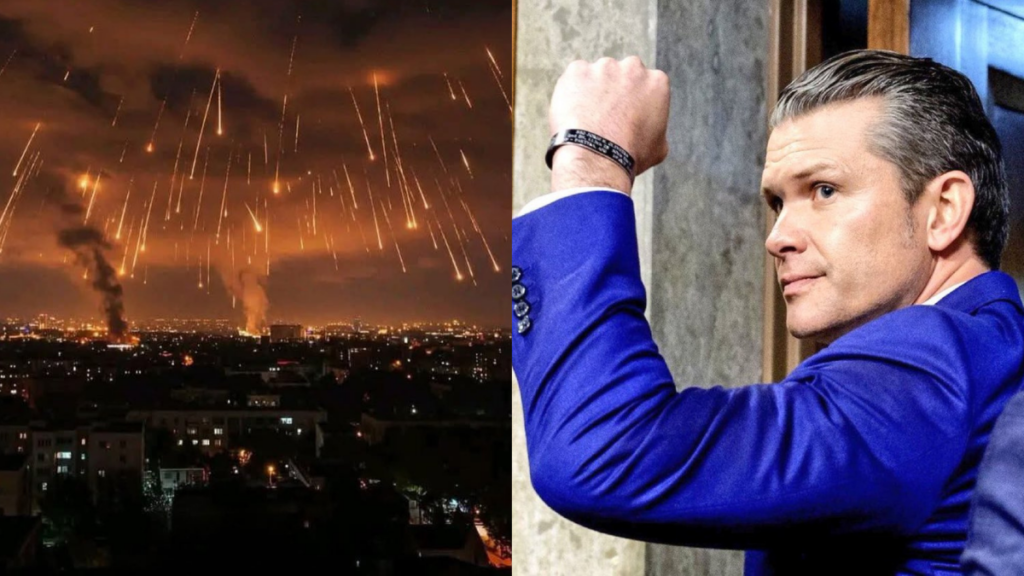
War Secretary Pete Hegseth delivers stark warning about Iran’s underground nuclear ambitions while standing firmly behind Trump’s decisive military action. He delivered a forceful and unflinching message to the nation this week, declaring that the United States “didn’t start this war, but we will finish it” as he revealed what he described as a deeply troubling nuclear threat developing under the Iranian regime.
Pete Hegseth spoke as the Pentagon confirmed that a fourth U.S. service member had died following Iranian strikes on an American base in Kuwait, a sobering development that underscored the gravity of the moment.
“War is hell and it always will be,” Secretary Pete Hegseth said, acknowledging the painful cost as American troops continue operating in a volatile region. His remarks came as officials confirmed the additional casualty, marking another tragic loss in the escalating confrontation.
Overnight, on President Trump’s orders, the Department of War commenced OPERATION EPIC FURY — the most lethal, most complex, and most-precision aerial operation in history.
The Iranian regime had their chance, yet refused to make a deal — and now they are suffering the…
— Secretary of War Pete Hegseth (@SecWar) February 28, 2026
Speaking during a Pentagon briefing following U.S. strikes on Iranian targets, Pete Hegseth made clear that the military action authorized by President Donald Trump was not the beginning of hostilities, but rather a response to years of aggression and escalating danger.
The War Secretary laid out what he described as mounting intelligence showing Iran had continued advancing elements of its nuclear capabilities, including infrastructure buried deep beneath mountainous terrain. Pete Hegseth stressed that such secretive construction is inconsistent with peaceful nuclear energy.
“Peaceful nuclear programs are not hidden under mountains,” Donald Trump’s War Secretary said, pointing to hardened underground facilities that U.S. officials believe were designed to shield critical components from airstrikes.
According to Hegseth, the administration’s actions were aimed squarely at neutralizing offensive capabilities — including missile systems and naval assets — that posed a direct threat to American forces, allies in the region, and potentially the U.S. homeland.
He emphasized that the campaign was not about regime change but about eliminating imminent threats. “This is not Iraq. This is not endless war,” Hegseth said, drawing a clear contrast with past prolonged military engagements.
Pete Hegseth also highlighted what he described as nearly five decades of hostility from Tehran. He referenced attacks carried out by Iranian-backed proxy groups, missile strikes, and what he characterized as persistent anti-American operations throughout the Middle East.
U.S. Secretary of War Pete Hegseth:
As time goes by, we are becoming stronger and the Iranians are growing weaker.
We are setting the terms of this war—from beginning to end.
We are not striving for a utopian goal. We are realists. pic.twitter.com/ONPzzpbZ1Y
— ((Hurkle Durkling)) 🇺🇸 🤟 🇮🇱 (@durklinghurkle) March 2, 2026
“For decades, the Iranian regime has waged a one-sided campaign against the United States,” he said. “Through proxies, through terror, through bloodshed.”
The remarks closely align with President Donald Trump’s longstanding position that Iran must never obtain a nuclear weapon. Trump has repeatedly warned Tehran that any move toward weaponization would trigger decisive consequences.
Following the Iran strikes, Donald Trump reiterated that stance, stating that America will not allow a regime that openly threatens its allies and chants “Death to America” to possess nuclear arms.
Secretary Hegseth’s tone during the briefing was resolute but measured. While underscoring the seriousness of the threat, he also projected confidence in the mission’s clarity and scope. The operation, he said, was carefully targeted to dismantle offensive systems and prevent further escalation.
At one point, Pete Hegseth issued a direct warning to any entity contemplating harm against Americans. “If you threaten Americans anywhere in the world, we will find you,” he said. “And we will hold you accountable.”
Officials have not publicly detailed the full extent of the intelligence that prompted the timing of the strikes, but Hegseth made clear that the decision was not taken lightly. He described a rapidly developing situation in which delaying action would have increased the danger.
The Pentagon chief also praised American service members, calling them disciplined and prepared, and underscored that the operation was executed with precision. “This was about protecting American lives,” Pete Hegseth said.
As tensions continue in the region, the administration maintains that its objective is deterrence, not expansion of conflict. Hegseth repeated that the United States does not seek a broader war but will respond firmly to any retaliation.
The message was unmistakable: the United States views the emerging nuclear infrastructure and regional aggression as unacceptable risks.
Pete Hegseth’s declaration that “we didn’t start this war” framed the unfolding events as a defensive response to escalating threats — a position strongly backed by President Trump, who has consistently vowed that America will act when its security is on the line.
With the world watching closely, the Donald Trump administration is signaling that it believes decisive action now may prevent a far more dangerous confrontation later.


