



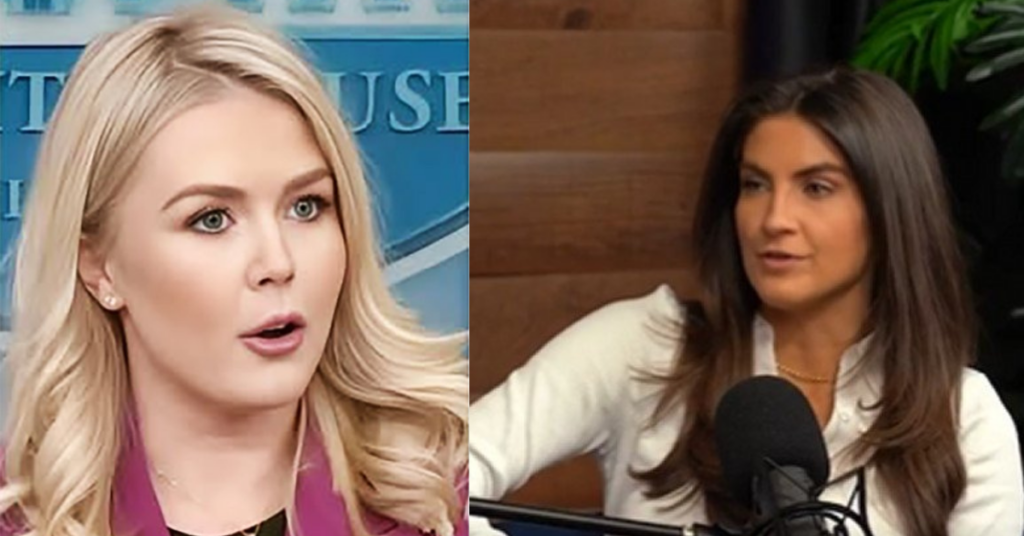
In a striking moment that cut across the usual cable news divide, CNN host Kaitlan Collins revealed that White House press secretary Karoline Leavitt stepped in to defend her access when members of the Saudi Royal Guard allegedly “freaked out” during a high-profile trip.
Collins recounted the episode during a recent broadcast, describing a tense exchange as U.S. reporters attempted to cover events involving President Donald Trump in Saudi Arabia. According to Kaitlan Collins, Saudi security officials moved aggressively to limit press access, creating confusion and confrontation among members of the traveling press pool.
CNN’s Kaitlan Collins Says Karoline Leavitt Defended Her Free Press Rights
“The Saudi Royal Guard freaked out because I dared to ask a question … and said, you can’t come into the next event … Karoline, to her credit said, no Kaitlan’s coming in with the rest of the U.S.… pic.twitter.com/uhB9al4GVX
— Chief Nerd (@TheChiefNerd) February 12, 2026
“That was actually a moment where the Saudi Royal Guard kind of freaked out,” Collins said, explaining that access to the president was suddenly restricted. She described how the situation escalated quickly as journalists tried to do their jobs in a tightly controlled foreign environment.
Collins said it was Karoline Leavitt who stepped in to resolve the standoff. “She defended us,” Kaitlan Collins acknowledged, adding that the press secretary worked to ensure American reporters were not blocked from covering the president. The CNN host made clear that Leavitt’s intervention was decisive in preventing the situation from deteriorating further.
The episode unfolded during official Trump administration engagements in Saudi Arabia, where strict security protocols and rigid press controls are common. Collins suggested that Saudi officials were not prepared for the level of media access typically expected during U.S. presidential travel.
At one point, Katilan Collins described how the Royal Guard appeared alarmed by the presence of cameras and reporters moving within proximity of the president. “They kind of freaked out,” she said, noting that access was abruptly curtailed.
Karoline Leavitt goes
scorched earth on Kaitlan Collins of CNN. pic.twitter.com/8ViCYPu5it
— 𝐃𝐔𝐓𝐂𝐇 (@pr0ud_americans) October 8, 2025
Rather than allowing the situation to spiral, Karoline Leavitt reportedly confronted the issue head-on. According to Collins, the press secretary insisted that American journalists be permitted to carry out their coverage responsibilities.
Kaitlan Collins’ on-air comments marked a rare moment of public acknowledgment from a CNN anchor praising a senior Trump administration official. While Karoline Leavitt has frequently sparred with reporters during White House briefings, Collins’ account painted a different picture — one of firm advocacy for press access abroad.
The CNN host did not downplay the intensity of the moment. She described confusion among reporters and what appeared to be an overreaction from Saudi security personnel. Yet she emphasized that Karoline Leavitt did not hesitate to step in.
Leavitt, one of the youngest press secretaries in modern history, has built a reputation for aggressively defending the administration’s positions from the briefing room podium. In this instance, however, her defense extended to protecting members of the press corps — including a network often critical of the White House and the Trump administration.
The exchange underscores the complexities of presidential travel in countries with different media norms and security practices. While U.S. administrations of both parties traditionally fight to maintain American press access overseas, such moments rarely become public anecdotes — especially from journalists perceived as adversarial.
Kaitlan Collins’ remarks about Karoline Leavitt highlight that even amid sharp domestic political divides, there are instances where White House officials and reporters find common ground in defending institutional press access.
The Saudi trip itself drew global attention, with high-level meetings and strategic discussions on the agenda. But Collins’ revelation added a behind-the-scenes glimpse into the tension that can unfold just steps away from official photo ops.
For Karoline Leavitt, the incident reinforces her role not only as the president’s spokesperson but also as a gatekeeper for the press corps’ access — even in challenging international environments.
And for Kaitlan Collins, the acknowledgment was clear: when the Saudi Royal Guard “freaked out,” it was Karoline Leavitt who intervened to ensure American reporters were able to do their jobs.


