



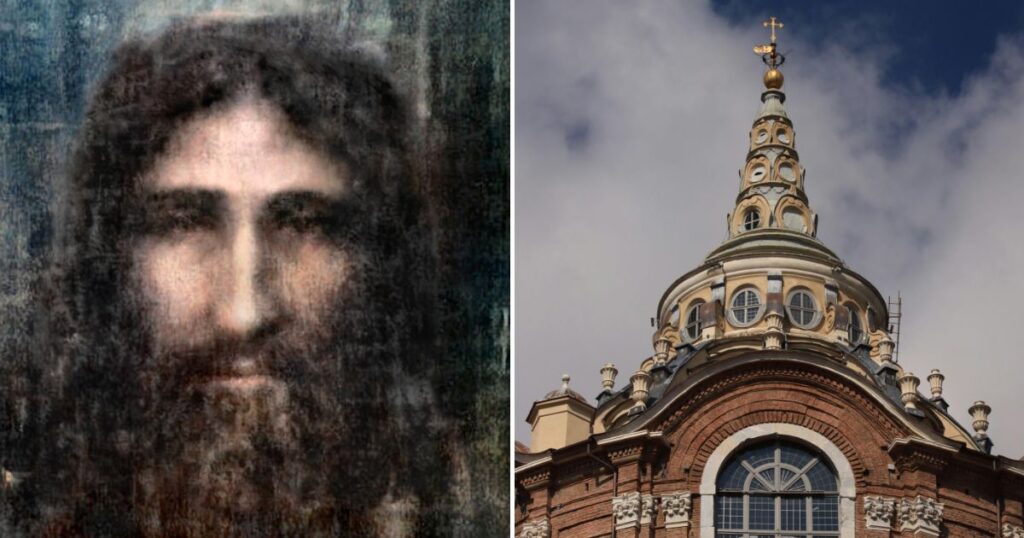
For centuries, the Shroud of Turin has been believed by some to be the burial cloth of Jesus Christ. It bears the faint outline of a man’s face and body, which has inspired devotion and extensive scientific analysis.
Now, a new study suggests that the image stamped on the cloth is not the imprint of a crucified body. According to Brazilian researcher Cicero Moraes, the face on the shroud does not behave like a real human face would if pressed into fabric. Instead, he argues, it behaves more like art.
While there is consensus that Jesus of Nazareth existed as a historical figure, debate continues over the relics tied to his life and death. The shroud has thus been one of the most hotly contested. Some researchers argue that stains on the linen are real blood. However, radiocarbon dating conducted in 1988 placed the cloth in the medieval period — between 1260 and 1390 — not the first century.
The latest experiment focuses on the cloth’s geometry.
The Shroud of Turin is a linen cloth that bears the image of a man who appears to have been physically crucified. It is believed by some to be the burial shroud of Jesus of Nazareth. pic.twitter.com/YSDmsTjQ6e
— Historic Vids (@historyinmemes) May 11, 2023
Moraes used 3D digital simulations to see what would happen if cloth were draped over a human face. He used open-source modeling software to compare the Shroud of Turin’s image with how a real head would distort fabric. He concluded that if a human face were pressed into linen, the imprint would be “more robust” and more distorted than the symmetrical face on the shroud.
The researcher argues that the shroud’s image is more of a low-relief artistic representation, similar to what medieval artists might have produced. But not everyone is convinced.
The Turin International Centre for Studies on the Shroud (CISS), Italy, said there was “nothing new” in this conclusion. The group argued that earlier investigations by the Shroud of Turin Research Project addressed such claims and that more recent measurements support the relic’s authenticity.
Moraes still insists that his work adds new digital evidence. He also noted that some STuRP members themselves have been skeptical about aspects of the shroud’s origins. He cited Dr. Joseph Accetta, who supported a medieval origin theory in 2019.
Is this the image of Jesus?
There’s a lot of talk about the Shroud of Turin lately, so let’s break down the evidence.
A new X-ray study suggests it’s 2,000 years old — but that’s just the beginning.
Buckle up… (thread) 🧵 pic.twitter.com/eygqmZd7rD
— The Culturist (@the_culturist_) January 21, 2025
The debate over the Shroud of Turin is separate from the question of Jesus Christ’s existence. Most historians, including secular scholars, accept that Jesus was a real first-century Jewish preacher who was crucified under Roman authority. The earliest writings about him come from Paul’s letters, written between A.D. 48 and 62. Paul claimed to have met Peter, John and James, the latter of whom is described as Jesus’ brother.
So the historical case for Jesus does not rest on a piece of linen in Turin.
NEXT UP: 1,500-Year-Old Manuscript Claims Jesus Married Mary Magdalene and Fathered Two Children With Her